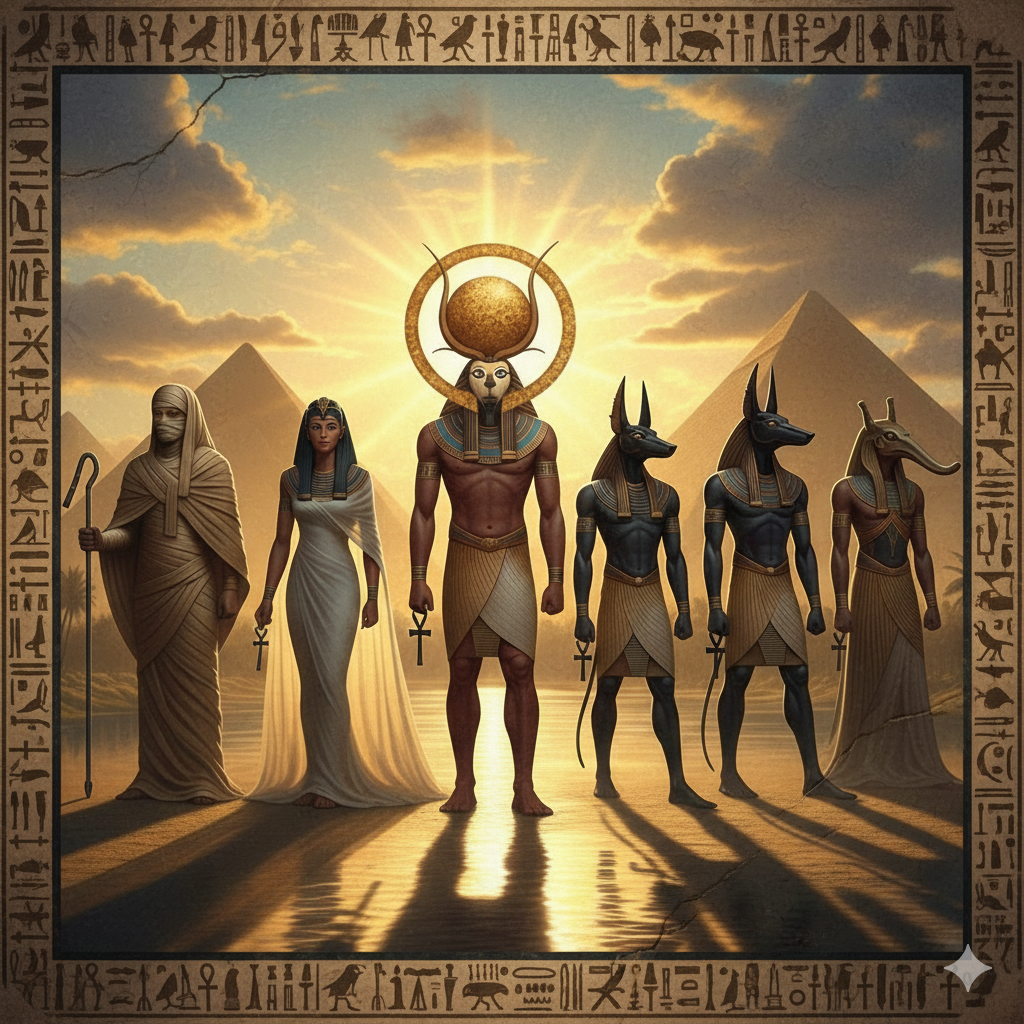
Imagine walking through the scorching sands of the Nile Valley five thousand years ago. For the ancient Egyptians, the world wasn’t just a physical space; it was a living, breathing tapestry of divine intervention. From the daily rising of the sun to the annual flooding of the river, every heartbeat of nature was governed by a complex family of deities. These gods weren’t distant, cold statues; they were emotional, powerful, and deeply involved in the human experience.
The Egyptian pantheon is one of the most enduring and fascinating religious systems in history. It shaped a civilization that lasted over three millennia, influencing art, architecture, and even modern concepts of justice and the afterlife. In this guide, we aren’t just listing names; we are embarking on a journey to understand how these beings provided a sense of order—what they called Ma’at—in an unpredictable world. Whether you are a mythology enthusiast or a curious traveler of the mind, this pillar article will serve as your gateway to the divine mysteries of Ancient Egypt.
Who Were the Egyptian Gods?
To understand the Egyptian gods, we must first discard the modern idea of “religion” as something separate from daily life. For an ancient Egyptian, there was no secular world. The gods were the environment. The wind was the breath of Shu; the earth was the body of Geb; the sky was the arched frame of Nut.
The Concept of Divinity
The Egyptians viewed their gods as multifaceted beings. They used the term Netjer to describe them, a word that implies a power or agency beyond the human scale. Interestingly, these gods were not omnipotent in the way modern monotheistic religions define God. They could be hurt, they could feel sorrow, and they even had complex family dramas that mirrored human life.
Gods as Forces of Nature
Instead of seeing a storm as a random meteorological event, an Egyptian saw the chaotic energy of Set. When the sun crossed the sky, it wasn’t a burning ball of gas; it was the god Ra navigating his solar barque through the heavens. This “animistic” perspective meant that humans lived in a constant dialogue with the divine. Rituals, temples, and daily offerings were not just traditions—they were necessary maintenance for the universe to keep functioning.
The Major Egyptian Gods
The pantheon is vast, featuring over 2,000 deities. However, a core group of “Great Gods” formed the backbone of Egyptian theology. Each of these figures represents a fundamental pillar of existence.
Ra: The King of the Gods
Ra is the undisputed sovereign of the Egyptian sky. As the sun god, he was the source of all life. Every morning, he was reborn in the east, and every night, he traveled through the underworld (Duat) to battle the serpent of chaos, Apep.
- Role: Creator, Bringer of Light, Ruler of the Heavens.
- Symbol: The Sun Disk (Uraeus), the Falcon.
- Learn More: Explore the [Solar Mysteries of Ra] in our dedicated deep dive.
Osiris: Lord of the Dead
Once a benevolent pharaoh on earth, Osiris was murdered by his brother Set. He was resurrected by his wife Isis, becoming the ruler of the afterlife. He represents the cycle of regeneration and the hope for eternal life.
- Role: Judge of the Dead, God of Fertility and Agriculture.
- Symbol: The Atef Crown, the Crook and Flail.
- Learn More: Read about the [Resurrection of Osiris].
Isis: The Mother of Magic
Isis is perhaps the most beloved goddess in history. Her reach was so wide that her cult eventually spread across the Roman Empire. She is the ultimate protector, using her cunning and magical prowess to heal the sick and protect her son, Horus.
- Role: Goddess of Magic, Motherhood, and Healing.
- Symbol: The Throne (her headdress), the Tyet (Knot of Isis).
- Learn More: Discover the [Spells and Wisdom of Isis].
Anubis: The Guardian of the Scales
Before Osiris took the throne of the underworld, Anubis was the primary god of the dead. With the head of a jackal, he oversaw the mummification process and guided souls to the Hall of Truth.
- Role: God of Mummification and Embalming.
- Symbol: The Jackal, the Imiut emblem.
- Learn More: Step into the [Chambers of Anubis].
Horus: The Sky Avenger
The son of Osiris and Isis, Horus is the legitimate heir to the throne of Egypt. His epic battles with his uncle Set are legendary. He represents the living Pharaoh—the divine bridge between the people and the gods.
- Role: God of the Sky, Kingship, and Protection.
- Symbol: The Eye of Horus (Wedjat), the Falcon.
- Learn More: The epic tale of [The Contendings of Horus and Set].
Set: The Necessary Chaos
Set is often misunderstood as a “devil” figure, but Egyptian thought was more nuanced. Set was the god of storms, deserts, and foreigners. While he was the murderer of Osiris, he was also the one who stood at the front of Ra’s boat to spear the serpent of chaos. He is the “Red God,” the power of the untamed wild.
- Role: God of Chaos, Storms, and Strength.
- Symbol: The “Set Animal” (a mysterious, unidentified creature).
- Learn More: The complexity of [Set: Hero or Villain?].
The Role of Gods in the Afterlife
For the Egyptians, death was not an end but a transition—a “going forth by day.” The gods played a crucial role in ensuring this transition was successful. This wasn’t a guaranteed right; it was an earned privilege.
The journey through the Duat was perilous, filled with monsters and magical gates. The ultimate test was the Weighing of the Heart. In the presence of Osiris, Anubis would place the deceased’s heart on a golden scale against the Feather of Ma’at (Truth). If the heart was heavy with sin, the monster Ammit would devour it, and the soul would cease to exist. If light as a feather, the soul entered the Field of Reeds—a perfect, eternal version of Egypt.
This focus on the afterlife is why we have the pyramids and the [Book of the Dead]. The gods were the judges, the guides, and the rewarders of a life lived in balance.
Symbols and Sacred Animals
Egyptian gods were rarely depicted as purely human. They often bore the heads of animals, which served as a visual shorthand for their characteristics.
- The Scarab: Symbol of Khepri (the rising sun) and the idea of transformation and spontaneous creation.
- The Ibis: Associated with Thoth, the god of wisdom and writing. The bird’s curved beak resembled a crescent moon and a pen.
- The Lioness: Represented Sekhmet, the goddess of war and destruction, symbolizing the fierce, scorching heat of the sun.
- The Ankh: Though not an animal, this “Key of Life” was held by almost every deity, representing their power to bestow eternal breath.
Understanding these [Symbols and Rituals] is like learning a visual language that unlocks the meaning behind every temple carving you see.
Why Egyptian Gods Still Matter Today
Why are we still talking about Ra and Isis thousands of years after their last temples were closed? It’s because the themes they represent are universal. We still struggle with the balance between order (Ma’at) and chaos (Set). We still fear the “weighing of our hearts” and wonder what lies beyond the veil of death.
Modern pop culture is saturated with Egyptian echoes—from superhero stories to blockbuster films. But beyond the entertainment, Egyptian mythology offers a profound philosophy: that the universe is a coherent, sacred place where every individual has a role to play in maintaining the cosmic harmony.
In a world that often feels chaotic, the ancient Egyptian call to live a life of “Ma’at”—truth, balance, and order—remains as relevant today as it was in the shadow of the pyramids.
Deepen Your Knowledge
If you want a deeper exploration of Egyptian gods, this book is a classic reference:
“The Complete Gods and Goddesses of Ancient Egypt” by Richard H. Wilkinson. This comprehensive guide provides an unmatched look at every deity, from the famous to the obscure, with stunning visuals and historical context.